To measure SEO, watch enquiries from Google first, then clicks, then everything else. Rankings are the least useful number on their own.
Monthly SEO reports are often full of rankings and charts that go up. The question you actually care about is simpler: is SEO bringing in customers? Answering it means looking at a few numbers, in the right order.
Which numbers matter most?
Enquiries that came from Google matter most. Rankings and traffic only count if they lead there.
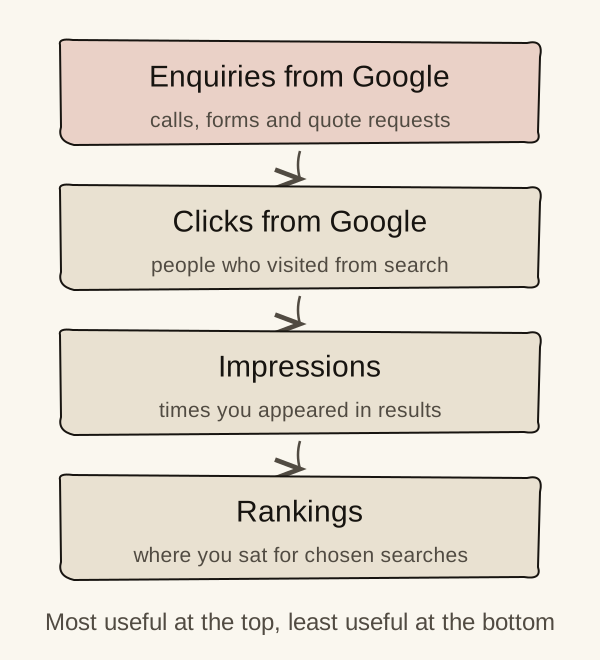
Each number is further from money than the one above it:
- Enquiries: calls, forms and quote requests from people who found you through Google search
- Clicks: people who visited your site from Google search
- Impressions: how often your site appeared in search results
- Rankings: where you sat for particular searches
For our made-up Hamilton heat pump installer, 12 quote requests from Google in a month says more than 40 new rankings for searches nobody hires from.
Counting enquiries needs some setup. Your website analytics should record form submissions and calls from the site, and show which ones started with a Google search. If that isn’t in place, fix it first, because without it every other number is a guess.
What does Search Console show you?
Search Console is Google’s free tool for website owners, and its Performance report is the most direct SEO data you’ll get.
It shows four main numbers: the clicks and impressions above, plus two more. Google defines them like this:Google says[1]
- CTR (click-through rate): clicks divided by impressions
- Average position: roughly where you appeared in the results
The most useful part is the list of queries: the actual searches people made before they saw or clicked on your site. It’s often the first time a business owner sees how customers really describe what they need.
Why can average position mislead?What the number actually measures, and why it moves for reasons that have nothing to do with your SEO.
In the main chart, Google calculates average position from the highest place your site reached in each search.[1] That means it’s averaged across many different searches, people and places. If your site starts appearing for lots of new searches, even low down, your average position can drop while your traffic grows. Read it alongside clicks, and look at position for the individual searches that matter to you rather than the site-wide average.
How long does SEO take?
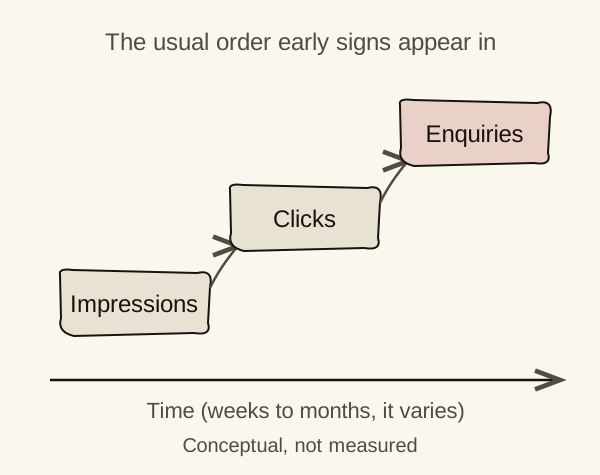
Results build over weeks and months, and vary a lot from site to site, so be wary of anyone who promises a fixed timeline.
Google’s own guidance is that some changes take effect in a few hours and others can take several months, and it suggests waiting a few weeks before judging whether a change worked.Google says[3] Part of the reason is that Google has to revisit a page before it sees your changes. Google also learns from how people respond to pages: the 2024 court ruling describes Google’s Navboost system as trained on 13 months of user data.Court evidence[4] The ruling doesn’t say how quickly a change shows up. We’d read it as a sign that this kind of learning builds over months, not days.
Where does AI search fit?
AI answers are another place customers can find you, and they need their own measures.
Search Console now includes a Generative AI performance report. It shows how often links to your site appeared in Google’s AI Overviews and AI Mode.Google says[2] It may not appear at all if your site hasn’t had enough of those impressions yet.[2]
Beyond Google, the simplest signals are visits from AI tools in your website analytics, and asking new customers how they found you. Our guide What is AEO? explains how AI answers use your website.
What should you ask an SEO supplier?
Good questions at the start get you more honest work than a long contract.
Whether you’re hiring someone new or reviewing an existing supplier, ask:
- Which searches are you going after, and why those? You want searches close to hiring, not just big numbers.
- Which pages will you create or change? “Optimising your website” isn’t an answer.
- How will we track enquiries from Google? If they can’t answer, the reports will be guesswork.
- What will you report each month? Look for enquiries and clicks, not just rankings.
- What won’t you do? A good supplier will say they don’t buy links or promise rankings.
Where should you start?
Start by making sure you can count enquiries from Google. Everything else depends on it.
- Set up enquiry tracking if you don’t have it.
- Open Search Console once a month and read the queries, not just the chart.
- Ask your supplier the five questions, and compare their reports against the answers.
End of the course
You’ve finished How SEO works
Sources
- Performance report (Search results)Google Search Console Help · Checked 5 November 2026↩ 1↩ 2
- Generative AI performance report (Search)Google Search Console Help · Checked 5 November 2026↩ 1↩ 2
- SEO Starter GuideGoogle Search Central · Updated 10 December 2025 · Checked 5 November 2026↩ 1
- United States v. Google LLC, Memorandum Opinion (Document 1033)US District Court for the District of Columbia · Published 5 August 2024 · Checked 5 November 2026↩ 1