Most people who pay for SEO find it hard to say what they’re paying for. That’s not their fault. SEO usually gets explained in jargon, often by the people selling it.
This course explains it plainly. It follows one made-up business, a heat pump installer in Hamilton, from the first time Google finds its website to the enquiries that come in.
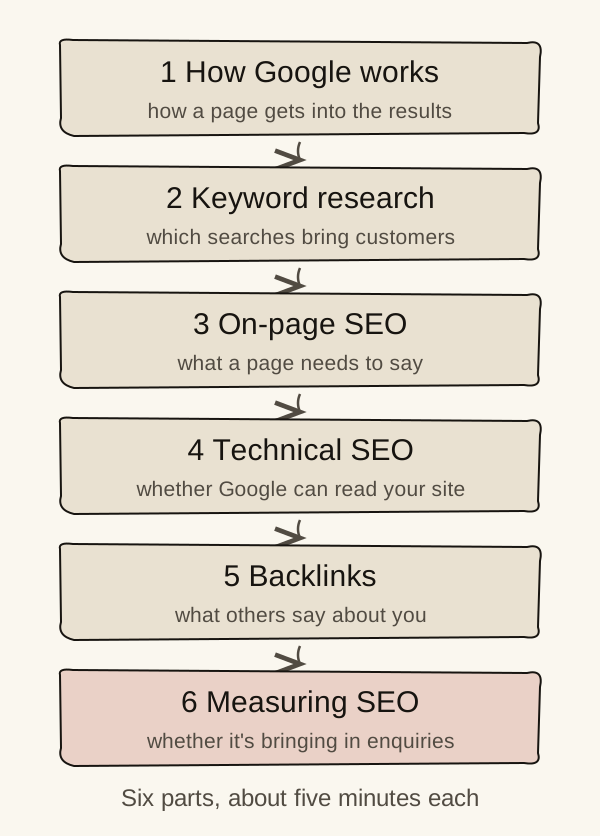
By the end, you’ll be able to:
- Explain the basics: why one business shows up in Google and another doesn’t
- Check your own site: find the obvious gaps using free tools, with one short task in each part
- Brief a supplier: tell useful SEO work from busywork, and ask questions that get honest answers
A lot of SEO advice is guesswork presented as fact. So claims in this course about how Google works carry a label saying where they come from, from Google’s own documentation to ideas that are widely believed but unproven. The key is below.
In this course
6 parts about 30 min
Part 1: How Google decides which websites to show
Finding, storing and ranking pages, and what happens after the score
6 min readPart 2: Keyword research: working out what your customers search for
Which searches matter, and why each one needs its own page
5 min readPart 4: Technical SEO: can Google actually read your website?
The checks that make sure Google can reach and read your site
5 min readPart 5: Backlinks: why other websites decide how much Google trusts you
Why links, mentions and reviews still decide who Google trusts
5 min readPart 6: How to measure SEO, and know if it's working
Which numbers to watch, how long it takes and what to ask a supplier
5 min read
How sure we are
| Label | What it means |
|---|---|
| Google says | Google's own documentation or public statements |
| Court evidence | Testimony, exhibits and rulings from the US Justice Department's case against Google |
| Leaked docs | Google's internal documents that leaked in 2024, and later reported files. They show a signal exists, not how much it counts |
| Industry belief | Widely held among SEOs but not confirmed. Also used to flag myths |