Backlinks are links to your website from other websites. Google still uses them to judge which pages to trust, and for a local business they sit alongside reviews and your Google Business Profile as your reputation online.
Your website can only say so much about itself. Google also looks at what the rest of the web says about you: who links to you, who mentions you, and what your customers write in reviews. For a local business, that reputation often decides who shows up first.
Do links still matter?
Yes. Links from other websites are still one of the main ways Google decides which pages to trust.
Google’s original breakthrough was PageRank, a way of judging a page partly by the links pointing to it and the quality of the pages those links come from. Google says PageRank has changed a lot since then, and that it’s still part of its core ranking systems.Google says[1] In trial evidence, a Google engineer lists anchors, meaning links from one page to another, as one of three fundamental ranking signals.Court evidence[6]
Links do a second job too. They’re the main way Google finds new pages in the first place, as part 1 explained.[2]
How does PageRank work?The idea behind link-based ranking, without the maths.
Imagine every link as a vote. A vote from a page that lots of other pages vote for counts for more than a vote from a page nobody links to. PageRank turned that idea into a calculation across the whole web. Modern Google combines link signals with many other systems, so no single link makes or breaks a page. The underlying idea still holds: who points to you matters, and so does who points to them.
What does a good link look like?
The most useful links come from real websites your customers might actually read.
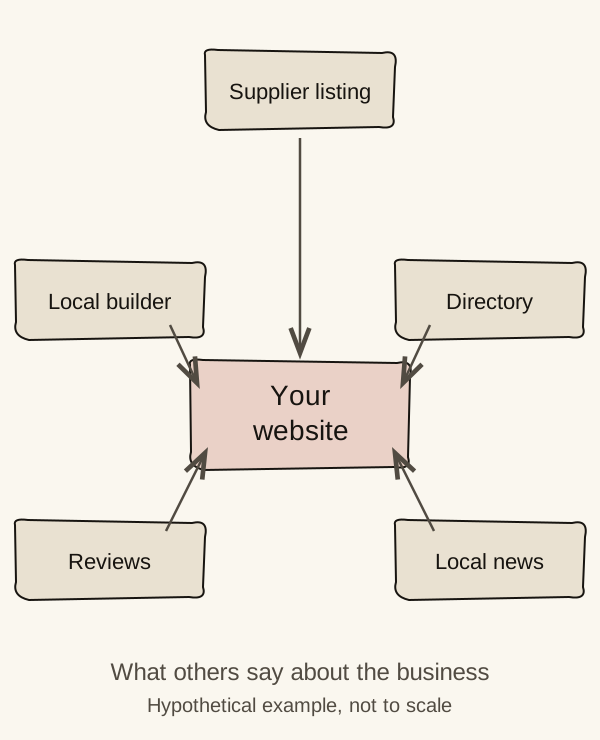
For our made-up Hamilton heat pump installer, good links might come from:
- suppliers: a manufacturer’s “find an installer” page
- partners: a local builder or electrician who recommends them
- directories: a trade association or a well-used local business directory
- local media: a story in the local paper, or a community event they sponsored
Most SEOs agree that relevance and real-world credibility matter far more than the number of links.Industry belief That view fits Google’s rules, which target links created mainly to manipulate rankings.[3] A link that exists because of a genuine relationship is the opposite of that.
Is it safe to buy links?
No, not to boost your rankings. Paying for links that pass ranking value breaks Google’s spam policies.
Google’s definition is clear. Link spam is creating links mainly to manipulate search rankings, and it includes buying or selling links for ranking purposes. Sites that break its policies may rank lower or not appear at all.Google says[3]
Paid links aren’t banned outright. Advertising and sponsorship are fine, as long as the link is marked with a small piece of code, rel="sponsored" or rel="nofollow", that tells Google not to count it for rankings.Google says[4] If someone offers you a bundle of links “to boost your SEO”, those are exactly the links Google’s rules are written to catch.
Do mentions and reviews count?
Reviews do, for local results. Mentions without a link probably help too, but that’s less certain.
Google says more reviews and positive ratings can help a business’s local ranking, and that replying to reviews shows you value feedback.Google says[5] Many SEOs also believe Google notices when a business is named without a link, such as in a news story, and when people search for a business by name.Industry belief
Consistency matters as well. RESONEO’s review of Google’s internal files suggests that when sources disagree about a business fact, such as opening hours, Google gives more weight to facts that several independent sites agree on.Leaked docs[7] So keep your business name, address, phone number and hours the same on your website, your Business Profile and every directory.
Reputation matters for AI answers too. AI tools that search the web can draw on what other websites say about a business, not just on its own pages. Our guide What is AEO? covers that side.
How does your Google Business Profile fit in?
For local searches, your Google Business Profile is often the first thing a customer sees, before your website.
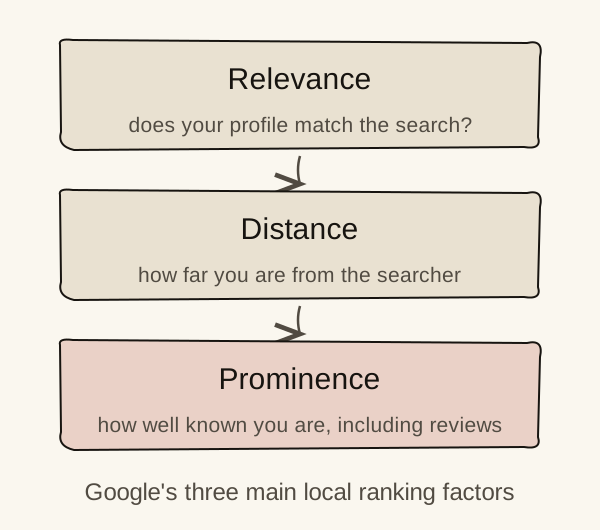
It’s the listing that appears in Google Maps and in the map results for local searches. Google says local results depend mainly on three things:Google says[5]
- Relevance: does your profile match the search?
- Distance: how far you are from the searcher
- Prominence: how well known you are, including reviews
Google also says there’s no way to pay for a better local ranking.[5] You can’t change your distance from a customer, but you can make your profile complete and accurate: the right categories, service areas, hours, photos, and replies to reviews.
Where should you start?
Start with your Business Profile, because it’s the quickest win for most local businesses.
- Fill in your Google Business Profile completely, and keep it up to date.
- Ask happy customers for reviews, and reply to the ones you get.
- List five real businesses or organisations that could reasonably link to you: suppliers, partners, associations, local media.
- Never pay for links that aren’t marked as sponsored.
Sources
- A guide to Google Search ranking systemsGoogle Search Central · Updated 10 December 2025 · Checked 5 November 2026↩ 1
- SEO Starter GuideGoogle Search Central · Updated 10 December 2025 · Checked 5 November 2026↩ 1
- Spam policies for Google web searchGoogle Search Central · Updated 28 August 2026 · Checked 5 November 2026↩ 1↩ 2
- Qualify your outbound links to GoogleGoogle Search Central · Checked 5 November 2026↩ 1
- Tips to improve your local ranking on GoogleGoogle Business Profile Help · Checked 5 November 2026↩ 1↩ 2↩ 3
- Call notes with Google engineer HJ Kim, 18 February 2025 (trial exhibit PXR0356)US Department of Justice · Checked 5 November 2026↩ 1
- Knowledge Graph: how Google feeds, maintains and grows its graphRESONEO · Checked 5 November 2026↩ 1