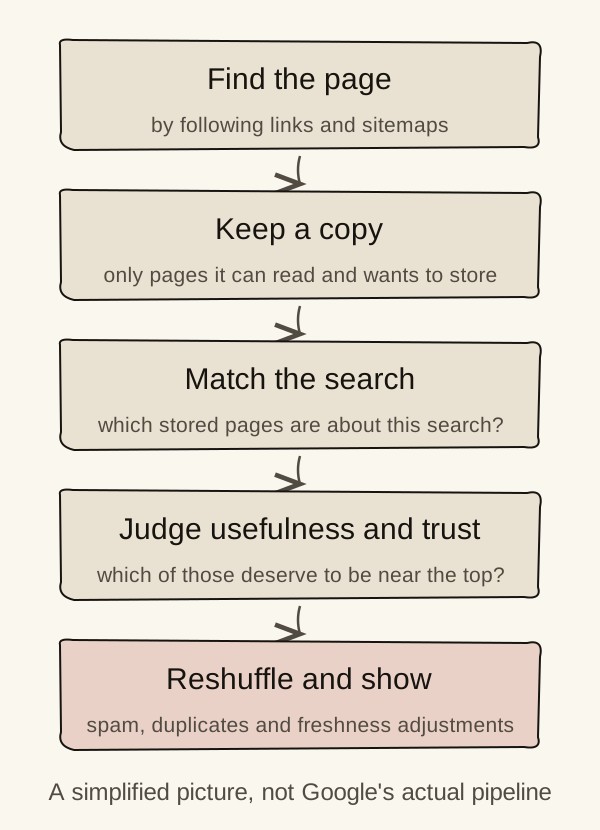
Google decides what to show in a series of steps. It finds pages, keeps a copy of the ones it can read, works out which of those match a search, then adjusts the order before showing the results.
Search “heat pump installation Hamilton” and the same few businesses come up every time. If you run one of the others, it’s easy to assume they paid for it or got lucky. Usually neither is true. Those businesses simply do better at more of the steps.
Throughout this course we’ll follow one business: a heat pump installer in Hamilton. It’s made up, but its problems are common ones.
How does Google find your pages?
Google can only show a page it knows about, and it finds most pages by following links from pages it has already seen.
There’s no central list of every website. Google discovers new pages when it spots a link to them on a page it already knows, or when a site owner submits a sitemap, which is a list of the site’s pages.Google says[1] Google’s starter guide puts it simply: it finds pages mainly through links from pages it has already crawled.[2] Crawling just means Google’s software visiting a page to read it.
Our installer recently added a page about heat pump servicing. Nothing on the site links to it yet, and it isn’t in a sitemap. As far as Google is concerned, it may as well not exist.
What does Google keep?
Finding a page isn’t enough. Google keeps a copy only of pages it can read and decides are worth storing.
This step is called indexing: Google works out what the page is about and adds it to its index, its huge store of web pages. Google is clear that this isn’t guaranteed. Not every page it processes gets indexed.Google says[1]
When several pages look very similar, Google groups them and picks one to show. That chosen page is called the canonical.[1] So if your site has five near-identical suburb pages, Google may only ever show one of them.
How does Google decide the order?
Google doesn’t rank pages on one score. It weighs several kinds of signal, then adjusts the results before you see them.
Google says it uses many automated ranking systems, and that relevance depends on hundreds of factors, which can include the searcher’s location, language and device.Google says[1][3] The antitrust case against Google gave a clearer picture of the main ingredients. In notes from a 2025 call with Google engineer HJ Kim, filed as a trial exhibit, he describes three “fundamental signals”:Court evidence[7]
- Anchors: links from other pages pointing to the page
- Body: the words in the page itself
- Clicks: historically, how long searchers stayed on a page before going back to the results
The same notes describe a site quality signal, Q*, as largely static and “largely related to the site rather than the query”.[7] In plain terms, Google forms a view of your whole website that follows every page into every search.
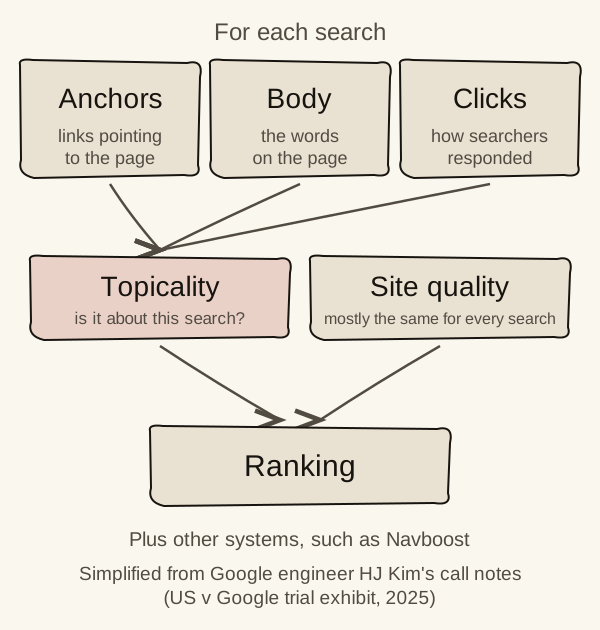
Then the results get adjusted. Google confirms some of the systems that do this, such as removing near-duplicates, favouring fresh results when a search needs them, and detecting spam.Google says[3] Leaked internal documents suggest there are many more. In 2024, more than 2,500 pages of Google’s internal documentation leaked, describing over 14,000 attributes.Leaked docs[8] RESONEO, a French SEO agency, has since reported finding about 120 of these adjustment systems, known as twiddlers, in internal files it reviewed.Leaked docs[9] The leak shows systems like these exist. It doesn’t show how much each one counts.[8]
Does what people do after they click matter?
Yes. Google watches whether searchers find what they wanted, and uses that to adjust future rankings.
The court’s 2024 ruling in the antitrust case describes a system called Navboost that “pairs queries and documents through memorizing user click data”. In other words, Google remembers which results people clicked for each search. The ruling says Navboost is trained on 13 months of user data.Court evidence[6]
The practical lesson we’d take from this: a page that people click and then quickly leave, because it didn’t answer their question, is unlikely to hold its place against a page that does.
Where do AI answers fit?
Google’s AI Overviews and AI Mode are written using pages Google has already found and stored, so the same steps decide which websites they can link to.
Google says a page needs to be indexed, and eligible to appear in search with a snippet, to be shown as a link in these AI features. It also says there are no extra requirements or special optimisations needed.Google says[5] Our guide What is AEO? explains how AI answers use your website in more detail.
Why does a court case count as evidence?Why we treat trial evidence differently from Google's blog posts and from industry opinion.
Google’s public documentation tells you what Google is willing to say. The antitrust case was different. Google engineers gave sworn testimony, internal documents became exhibits, and the judge’s findings were argued over by both sides. That makes court evidence some of the most reliable information available about how Google Search works on the inside. It still only covers what the case needed to examine.
Where should you start?
Start by making sure Google can find and store the pages that matter to your business.
- Link to every important page from somewhere on your own site, such as your menu or a related page.
- Check Google has those pages. The task below gives you a quick first look.
- Judge each page by whether a searcher would be satisfied after clicking, not by how many times it mentions a keyword.
Sources
- In-depth guide to how Google Search worksGoogle Search Central · Updated 18 December 2025 · Checked 5 November 2026↩ 1↩ 2↩ 3↩ 4
- SEO Starter GuideGoogle Search Central · Updated 10 December 2025 · Checked 5 November 2026↩ 1
- A guide to Google Search ranking systemsGoogle Search Central · Updated 10 December 2025 · Checked 5 November 2026↩ 1↩ 2
- site: search operatorGoogle Search Central · Checked 5 November 2026↩ 1
- AI features and your websiteGoogle Search Central · Updated 10 December 2025 · Checked 5 November 2026↩ 1
- United States v. Google LLC, Memorandum Opinion (Document 1033)US District Court for the District of Columbia · Published 5 August 2024 · Checked 5 November 2026↩ 1
- Call notes with Google engineer HJ Kim, 18 February 2025 (trial exhibit PXR0356)US Department of Justice · Checked 5 November 2026↩ 1↩ 2
- An anonymous source shared thousands of leaked Google Search API documents with meSparkToro · Published 27 May 2024 · Checked 5 November 2026↩ 1↩ 2
- Twiddlers: what still moves a result after rankingRESONEO · Checked 5 November 2026↩ 1