Keyword research is working out what your customers type into Google, then making sure each of those needs has one good page on your website.
Ask a business owner what they want to rank for and they’ll usually name their trade. Customers rarely search that way. They search for the problem they have, the place they live and the decision in front of them, and each of those needs a different page.
What is a search really asking for?
A search tells you what someone is trying to get done, and that matters more than the exact words they type.
Google’s own advice is to think about the words a person might use to find your content. It notes that people who know a subject well often search differently from newcomers.Google says[1] Google also matches pages to searches that don’t use exactly the same wording, so you don’t need a separate page for every variation.[1]
SEOs call the purpose behind a search its intent. For our made-up Hamilton heat pump installer, searches fall into four rough groups:
- Learning: “why is my heat pump not heating”
- Comparing: “daikin vs mitsubishi heat pump”
- Ready to hire: “heat pump installation hamilton”
- Looking for you: “[business name] reviews”
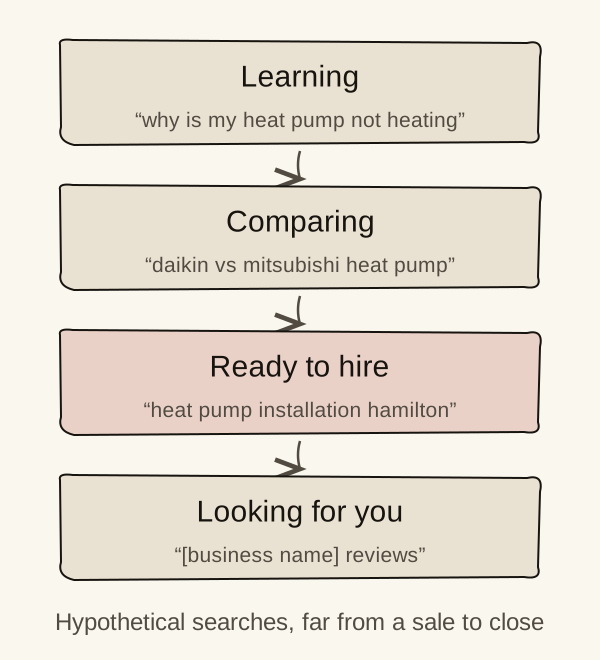
Each group wants something different. Someone asking why their heat pump isn’t heating wants an answer. Someone searching “heat pump installation Hamilton” wants a business they can call today. One page can’t serve both well.
How many people search for each thing?
Keyword tools estimate how often things are searched, and in small markets those estimates are thin.
The tools build their numbers from samples of data, then scale them up. That works reasonably well for big, common searches. For a search made a few dozen times a month in one New Zealand city, a tool may show zero even when real customers are typing it.
An example from our own research: in Ahrefs, a popular keyword tool, “how to measure seo” showed no measurable searches in New Zealand and about 50 a month in Australia when we checked in November 2026. Zero there means the tool saw too little data, not that nobody searches for it.
So use the numbers to compare. If one search shows 500 a month and another shows 20, the first is probably bigger. Don’t use them to forecast how many enquiries you’ll get.
Where do keyword numbers come from?Why two keyword tools can give you very different numbers for the same search.
Google doesn’t publish an exact count for every search. Keyword tools typically combine data such as advertising estimates, browsing panels and their own checks of search results, then model the rest. Each tool uses different data and a different model, so their numbers often disagree, and small or local searches are where they disagree most. The safest use is the same in every tool: compare searches against each other, inside one tool, at one time.
Why does each need want its own page?
Each need should have one clear page, so Google doesn’t have to guess which of your pages answers it.
When Google finds pages that are near-duplicates, it groups them and usually shows only one.Google says[2] Pages that only overlap aren’t merged that way, but many SEOs find they still hold each other back. This is called cannibalisation: your pages competing with each other instead of with your competitors.Industry belief
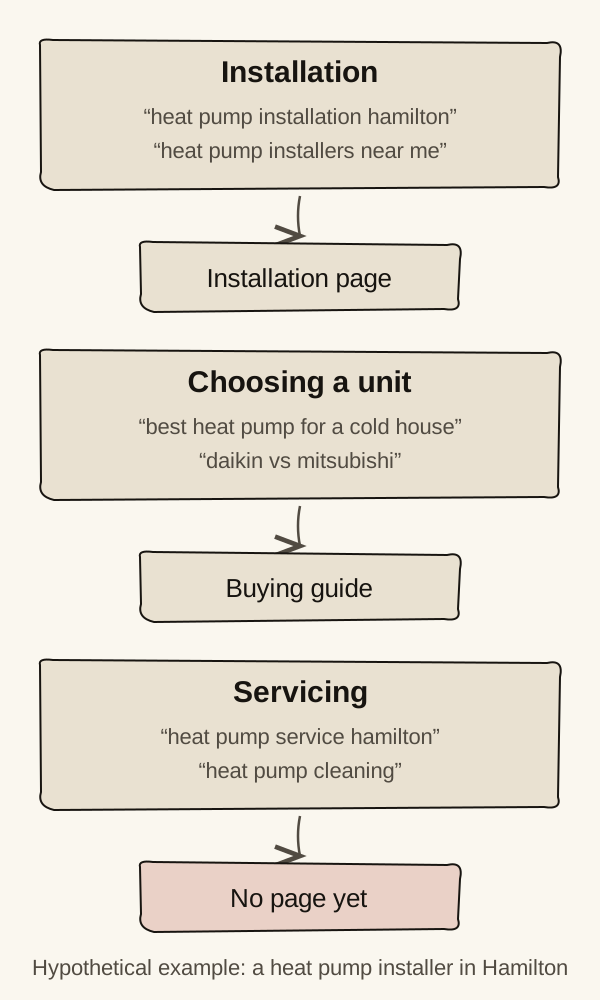
For our installer, the plan is three pages: one for installation, one buying guide for choosing a unit, and one for servicing. The servicing page doesn’t exist yet, so those searches have nowhere to go.
What can the results page tell you?
The results Google shows today are your best clue to the kind of page it thinks fits a search.
Search for something yourself and look at the type of results, not just the businesses. If the top results are local businesses with a map, a blog post is unlikely to break in. If they’re buying guides and comparisons, a sales page will struggle. Google says its systems aim to reward content made to help people,Google says[3] so what ranks now shows you what Google currently thinks helps.
RESONEO’s analysis of Google’s internal files suggests Google labels pages by type, such as product page, review or comparison, and links each kind of search to the types that suit it.Leaked docs[4] Whatever the mechanism, the advice is the same: build the kind of page the results already show.
Where should you start?
Start with the searches people make just before they hire someone.
These usually combine a service with a place (“heat pump installation Hamilton”), or include words like “near me”, “cost” or “price”. Fewer people make them than broad searches like “heat pumps”, but the people who do are much closer to picking up the phone. Broad searches are also where national retailers and comparison sites compete, which makes them hard for a local business to win. At INCITE, we’d usually build or fix those pages first, then work outwards to comparisons and questions.
- List your main services and the places you work.
- Write down how a customer would search for each one, in their words rather than your trade’s.
- Check each need has exactly one page. Merge pages that overlap, and note the needs with no page.
Sources
- SEO Starter GuideGoogle Search Central · Updated 10 December 2025 · Checked 5 November 2026↩ 1↩ 2
- In-depth guide to how Google Search worksGoogle Search Central · Updated 18 December 2025 · Checked 5 November 2026↩ 1
- Creating helpful, reliable, people-first contentGoogle Search Central · Updated 5 October 2026 · Checked 5 November 2026↩ 1
- How Google matches pages to search intentRESONEO · Checked 5 November 2026↩ 1